
If you search for the word "chakras”, you will find countless colourful charts telling you which chakra belongs to which colour and what their function is. While these informational pieces are helpful, they miss the most important thing about understanding chakras: their relevance today and their framework for understanding dimensions of the human experience. We all have chakras in our bodies; they might be activated or deactivated. Don’t worry if you’re not at all familiar with the chakras before or if the “spiritual talk” doesn’t come very naturally to you. This blog will take you through a reflection journey to understand the basics of chakras, their names, locations, colours, and what they mean in your life.
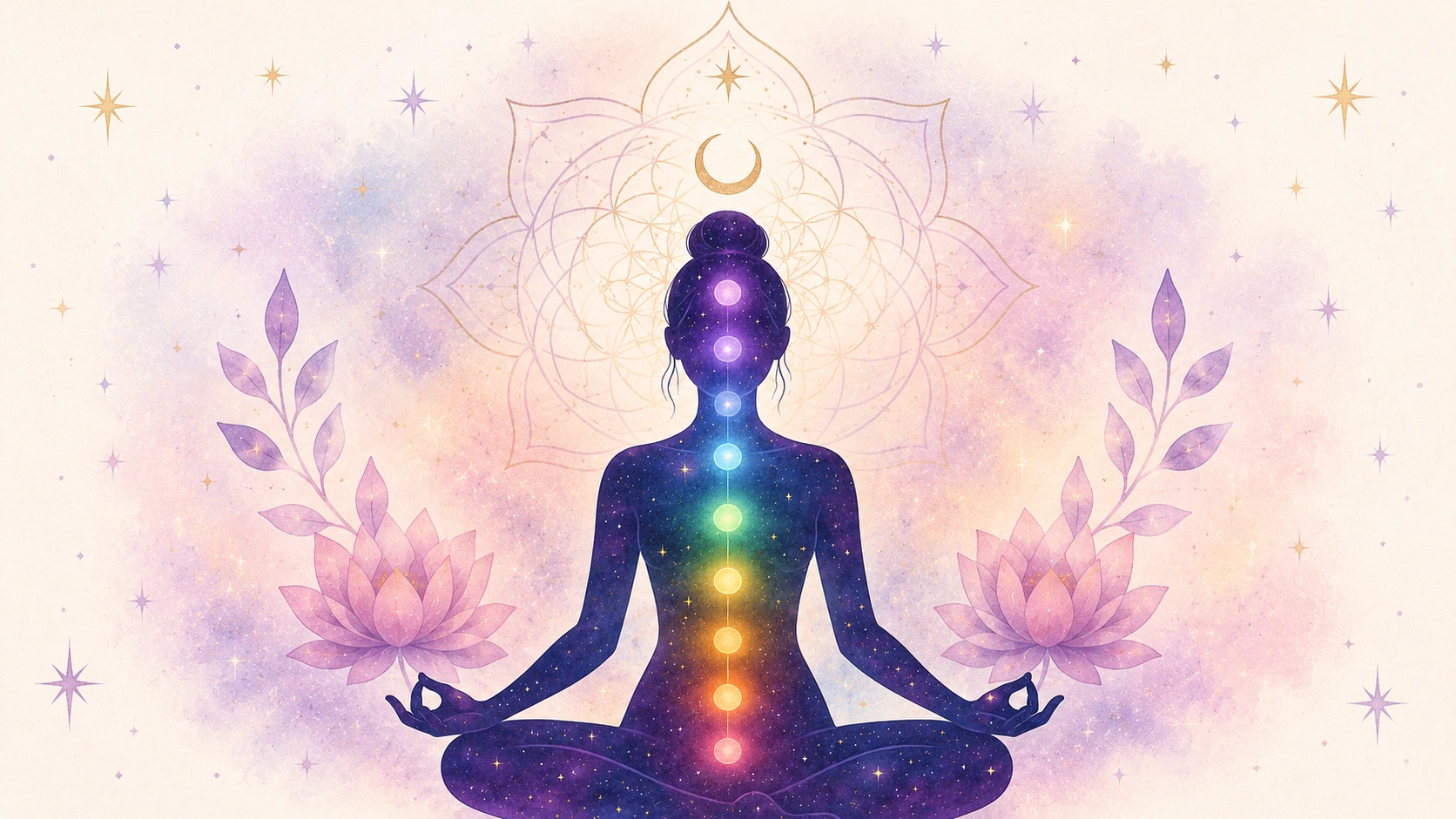
The 7 chakras in human body chart
| Chakra Name | Sanskrit Name | Location | Colour | Primary Function |
|---|---|---|---|---|
| Root Chakra | Muladhara | Base of the spine | Red | Safety, stability, grounding |
| Sacral Chakra | Svadhisthana | Lower abdomen | Orange | Creativity, emotions, pleasure |
| Solar Plexus Chakra | Manipura | Upper abdomen | Yellow | Confidence, personal power |
| Heart Chakra | Anahata | Center of chest | Green | Love, compassion, connection |
| Throat Chakra | Vishuddha | Throat | Blue | Communication, self-expression |
| Third Eye Chakra | Ajna | Between eyebrows | Indigo | Insight, awareness, intuition |
| Crown Chakra | Sahasrara | Top of the head | Violet or White | Meaning, spirituality, transcendence |
Root Chakra: The Need for Safety
The Root Chakra sits at the base of the spine and is associated with stability and security. Most people associate safety with physical protection, but psychological safety is just as important. Feeling secure in our finances, relationships, familial dynamics and career helps us be open to trying out new things, learn from our mistakes and grow. Interestingly, modern psychology supports this idea, as there’s plenty of evidence that shows that chronic stress and uncertainty can hamper our ability to regulate our emotions, build relationships and pursue long term goals. In a way, the root chakra is the foundation on which our most basic needs and psychological well-being depend.
Sacral Chakra: Emotional Flexibility and Creativity
The Sacral Chakra is often reduced to conversations about pleasure and sexuality, but it is so much more than that. The sacral chakra talks about emotional permeability – the ability to be transformed by life experiences. Many of us go through with our emotional guards up. We enter relationships not wanting to be vulnerable, we see art without wanting to be moved by it and we travel without genuine openness. What we often forget is that the opposite of emotional repression isn’t emotional expression. A balanced sacral chakra doesn’t mean being vulnerable at all times. It rather indicates the ability to surrender yourself to be affected by life. Similarly, an imbalanced sacral chakra doesn’t indicate a lack of creativity. It is the inability to surrender control to life so that it can change you.
Many adults have lost access to the sacral chakra because every single activity is being evaluated for its usefulness. The exercise we do, the food we eat, the career we choose, and the clothes we wear. Thus the activation of the sacral chakra can be understood as resistance against the tyranny of optimisation.
Solar Plexus Chakra: Identity As A Performance
Located in the upper abdomen, the Solar Plexus Chakra is linked to confidence and personal power. Many of us try to control outcomes through changing people, situations or ourselves. But genuine self-confidence comes from believing that we can deal with life’s challenges even when they feel uncertain. Psychologists call this self-efficacy, or the belief in our capabilities to navigate life’s demands. The solar plexus chakra symbolises our inner belief of capability and agency.
The deeper question to ask yourself if you really want to reflect is “Who is writing the script of your life?”
This question is important to think about because a lot of times, most people around us are making the important decisions of our lives without us knowing about it. Because of this, many people experience confidence issues because the situations and decisions they’re put in aren’t theirs to begin with anyway. Instead, they are inherited from family, friends, culture and social media. Thus, sometimes the problem isn’t low confidence. It’s about asking yourself whether you’re struggling with low self-esteem for decisions that weren’t yours to take.
Heart Chakra: The Courage To Revise Our Stories About People
The Heart Chakra is associated with love, compassion and connection. While it is often talked about in romantic terms, it extends to much beyond intimate relationships. Research suggests that supportive relationships are the highest predictor of well-being and resilience. Yet, connection requires vulnerability from our end and being okay with others changing throughout the course of relationships. Humans tend to freeze others into a narrative that can really rupture or prevent us from entering into a meaningful relationship with them. For example, people can be forever labelled as “the difficult friend, the selfish partner or the irresponsible parent"
The activation of the heart chakra can be viewed as opening a door to psychological flexibility in relationships. So, the next time you’re having a difficult time accepting change in relationships, ask yourself: “Can we let people be different than who they were once?” “Can we revise stories about them?”
Throat Chakra: The Cost of Being Understandable
The Throat Chakra symbolises communication and self-expression. Most people assume that communication often takes place by talking. But it involves honesty, boundaries and authenticity. Many of us know what we feel, but we struggle to express it. We avoid conversations, suppress emotions, or say what we think others want to hear. Over time, this can create frustration, self-hatred and resentment.
Many times, we also find it difficult to accept that people don’t understand or agree with us despite us trying our best to communicate well. The throat chakra talks about the tension between authenticity and comprehensibility. Being authentic sometimes means accepting that not everyone will understand us, and it’s okay to make peace with that.
Third Eye Chakra: The Ability To Witness Yourself
Located between the eyebrows, the Third Eye Chakra stands for intuition and insight. Popular culture often presents intuition as a mystical ability. But what most people don’t realise is that it can be understood as the brain’s capacity to recognise patterns based on experience.
The real challenge is not to develop intuition, but to distinguish it from assumptions and biases. Self-awareness requires us to question our own interpretations and remain open to alternatives. In this way, the third eye chakra represents curiosity, reflection and looking beyond just appearances.
The Third Eye Chakra also symbolises our ability to observe our own minds and stop negative characteristics from becoming our whole identity. So the next time you’re stressed, instead of saying “I’m anxious", try saying “I’m having anxious thoughts right now."
Crown Chakra: Meaning Without Uncertainty
The Crown Chakra sits at the top of the head and is associated with spirituality and transcendance. Beyond spiritual interpretations, it reflects a critical human need: the search for meaning. Psychologists have long observed that humans are keen to not just live but also find the true purpose behind their lives. Meaning and purpose can come from relationships, work, faith and family.
Modern culture often suggests that meaning comes after finding answers. But existential psychology suggests something different. Meaning often emerges while living the questions. Considering our world’s economic and socio-political state, it might be a good idea to learn to find meaning in uncertainty.
Conclusion
Whether or not people believe chakras are literally energy centres or not, the system remains remarkably relevant. The seven chakras map into many of the challenges people face every day: work, relationships, emotions, confidence and, most importantly, human growth. Perhaps this is why the chakra model has endured for centuries. If you're curious about how these themes show up in your own life,Healo's self-tests can help. Designed around the seven chakras, they offer personalised insights into areas such as emotional well-being, confidence, relationships, communication, and purpose, helping you better understand yourself and identify opportunities for growth.